
Saudi Arabia has done the hard part of the talent story in record time. The harder part is only starting, and it does not show up in a headcount report.
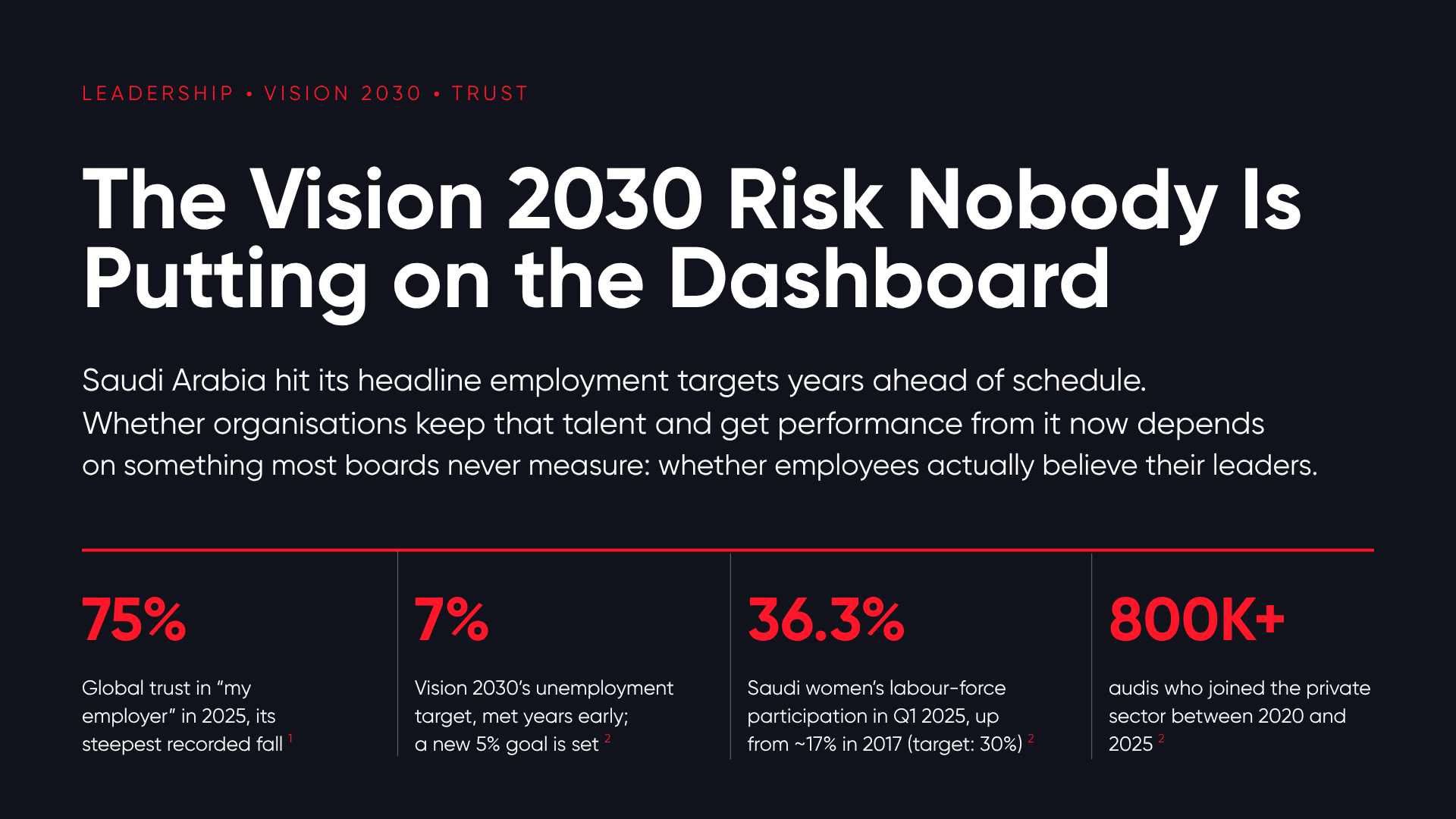
The Kingdom set out under Vision 2030 to put Saudis to work, and it has. The original target of cutting unemployment to 7% was reached years ahead of schedule, prompting a tougher new goal of 5%. Women’s labour-force participation has roughly doubled, from about 17% in 2017 to 36.3% in early 2025, already past the 30% Vision 2030 target. By the numbers, the jobs race is being won.
But filling roles and building organisations that perform are not the same achievement. As the giga-projects scale, sectors are built from scratch, and global firms compete for the same scarce Saudi talent, the binding constraint is shifting from creating jobs to keeping people and getting real output from them. That constraint runs on a single variable most leadership teams never put on a dashboard: trust in leadership.
The timing is not kind. Globally, trust in “my employer,” long the most-trusted institution people had, fell to 75% in 2025, its steepest recorded decline. Locally, the very success of the jobs push means competition for skilled Saudis is fierce, and the people an organisation most needs are the easiest to lose. Record hiring and intense competition for talent are happening at once. The organisations that hold their talent will not be the ones that talk about culture the most. They will be the ones whose leaders are believed.
The number your engagement survey is hiding
Most Saudi organisations do not have a culture problem they can see. They have a credibility problem their dashboards are not built to detect. Engagement scores measure how people feel this quarter. Credibility measures whether they believe what leadership tells them about next quarter, and that is the number that predicts whether your best people stay and whether your strategy actually moves.
The confusion is understandable, because most companies are now good at communication. Town halls, internal campaigns, leadership posts, all standard. But communication is not credibility. Communication is what leaders say. Credibility is whether employees believe it, based on what they have already watched leaders do.
Employees grant credibility slowly and withdraw it quickly. When credibility is high, every message compounds. When it is low, even excellent communication is discounted before it is heard.
Why 2030 raises the stakes, not lowers them
Transformation at this speed is a credibility stress-test. Every restructure, new mandate, localisation push, and reorganisation asks employees to extend belief ahead of evidence. They decide whether to do that based on one quiet question: did leadership keep its word last time? Where the answer is yes, change is absorbed and people move fast. Where it is no, the same announcement meets quiet resistance, hedging, and a CV going out the door.
This is why credibility is a business-readiness issue, not an HR nicety. A workforce that trusts its leaders executes faster, takes more initiative, and absorbs disruption, exactly the behaviours Vision 2030 demands. A workforce that does not trust its leaders waits, complies minimally, and leaves when a competitor calls. In a market this hot, the second pattern is expensive.
The AI test is really a trust test
The same logic now governs the conversation every leadership team in the Kingdom is having about AI. Whether AI is adopted or resisted inside an organisation has very little to do with the technology and almost everything to do with credibility. When leaders introduce AI into roles, employees run the same test they always do: is this being done with us, or to us? Has leadership been honest about what it means for our work?
Organisations with high credibility can deploy AI as an opportunity their people lean into. Organisations without it trigger fear, quiet resistance, and attrition no matter how good the tools are. Being business-ready for 2030 is, underneath the technology roadmap, a question of whether the workforce trusts leadership enough to change with it.
What leaders should measure, not assume
Most teams assume their culture is strong because their intentions are good and their messaging is positive. Intentions are not evidence. The organisations that build durable cultures measure how leadership is actually experienced, and act on the gap. That means moving past surface engagement metrics to questions that test credibility directly:
- Do employees believe leadership’s communications are honest and complete, including the bad news?
- Do leaders deliver on the commitments they make, especially the small ones?
- Are opportunities, recognition, and accountability seen as fair across teams and backgrounds?
- Do people trust leadership’s direction, and trust them to navigate the change required to reach it?
Credibility shows up in five everyday behaviours:
- Consistency. Values hold under pressure, not just on the easy calls.
- Follow-through. Commitments are kept, including the small ones people track.
- Transparency. Honesty in hard moments, not silence or spin.
- Fairness. Opportunity and accountability shared even-handedly.
- Candour. Leaders who will say “we got it wrong.”
None of these require a budget. They require leaders to behave the same way whether or not anyone is watching. The gap between how leaders believe they are perceived and how they are actually perceived is where culture quietly succeeds or fails. Measuring that gap honestly is not a threat to leadership. It is the most useful piece of management information a transforming organisation can hold.
Turning trust into a number you can manage
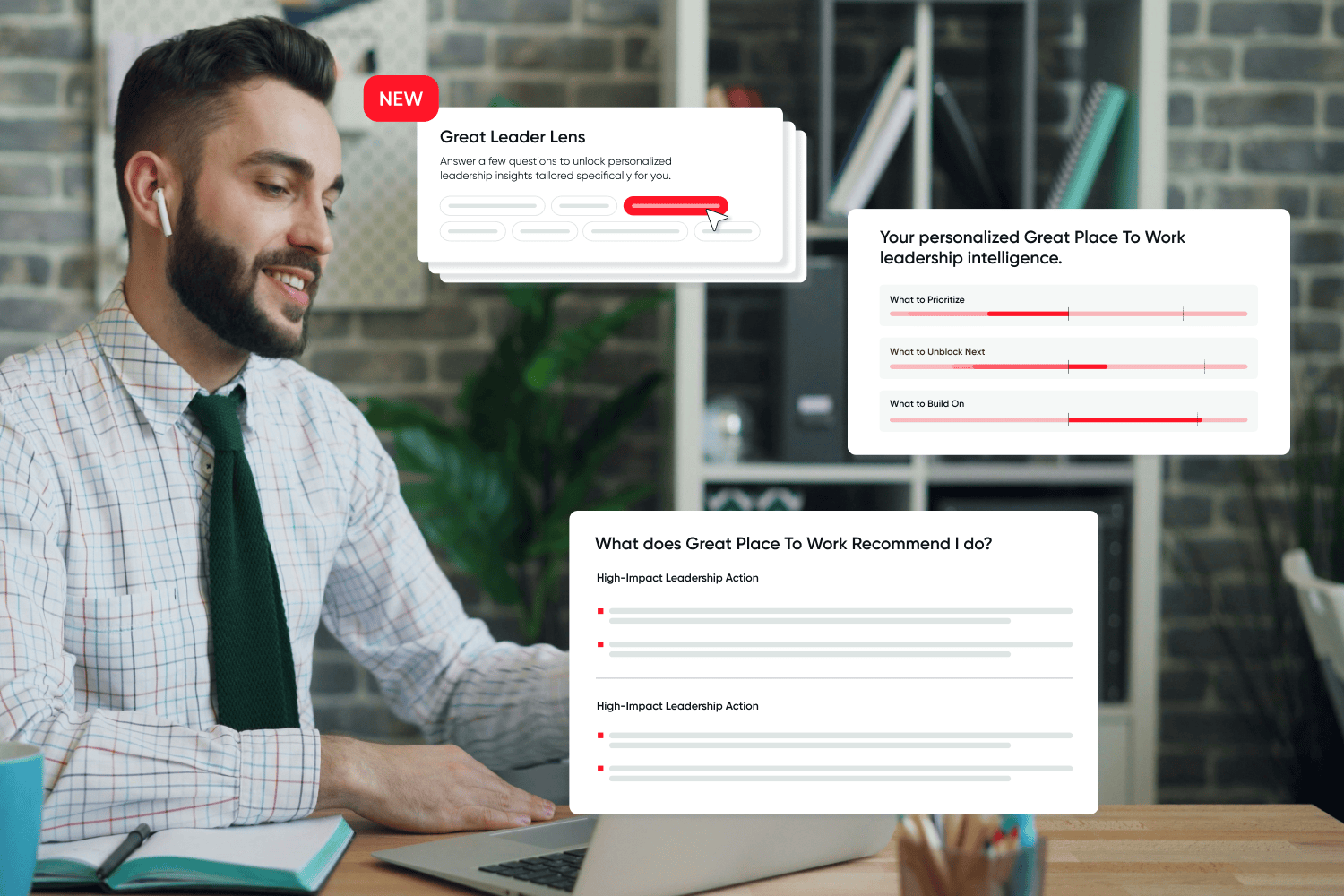
This is the work Great Place To Work exists to do: make trust measurable. Through the Trust Index survey and Culture Audit, organisations get an evidence base for how credibility, respect, and fairness are experienced across the workforce, where the gaps sit, and which leadership behaviours move them. Benchmarking against the best workplaces in the Kingdom turns internal opinion into an external standard, and Certification converts that into third-party proof that strengthens your position in a tight talent market.
Saudi Arabia has proven it can put people into jobs at a pace few economies can match. The next decade will be decided by a harder question: whether those people believe the leaders
they work for. Credibility, more than communication, is the currency that culture now trades in. The organisations that measure it will own the Vision 2030 talent race. The ones that assume it will keep wondering why their best people leave.
Sources
1. Edelman Trust Barometer 2025, trust in “my employer” and the record decline in employee trust.
2. Saudi Vision 2030 / GASTAT reporting, unemployment targets, female labour-force participation, and private-sector job growth.