

Most strategies do not fail in the boardroom. They fail on a Monday morning, when a manager has to explain what the strategy means for the people expected to deliver it.
The executive message says move faster. The manager has to decide which approval disappears. The strategy says put people first. The manager has to decide whether the target moves or the team works another weekend. The value says speak up. The manager decides what happens to the person who actually does.
Every one of those decisions is invisible from the top. Every one of them is the strategy, as far as employees are concerned.
This is the leadership translation gap: the distance between what an organisation announces and what its people experience. It is the least discussed risk in transformation, and the most expensive, because nothing looks wrong while it is happening. The slides are aligned. The town hall went well. And the strategy is quietly fragmenting, one team at a time, without anyone formally disagreeing with it.
The people carrying the change are the least supported
The Middle East is transforming at a pace that would have been unthinkable a decade ago. New sectors, new operating models, new technology, new talent pipelines, all at once. The World Economic Forum expects 39% of core job skills to change by 2030. Read that number carefully. It does not just mean people need training. It means the organisation depends, more every year, on the layer that makes change understandable and credible: managers.
Now look at what is happening to that layer. Gallup’s latest State of the Global Workplace found manager engagement fell to 22%, down from 31% in 2022. The people being asked to carry transformation into the workforce are carrying the strain of transformation themselves. And their influence is not a side effect. Great Place To Work research shows that leaders shape 70% of the employee experience. Seventy percent. For most employees, the organisation is not the CEO or the annual report. It is the person who assigns the work, approves the leave, explains the restructuring, and decides whose voice counts in the room.
Communication is not translation
Most organisations treat this as a communication problem. Another deck, another email, another leadership video. The message gets more polished. The meaning stays unclear.
Because employees are not asking what the strategy says. They are asking harder questions. What changes in how we work today? What stays non-negotiable when pressure rises? Which trade-offs are leaders actually prepared to make? What behaviour gets rewarded now, and what stops being accepted? And what will happen to the feedback we gave?
If managers cannot answer those questions, employees answer them for themselves. Different teams build different interpretations. Different locations live different standards. Nobody rejects the strategy. It just stops meaning anything specific.
Four moves that close the gap
1. Brief your managers before you announce anything
In most organisations, the cascade works like this: leadership announces, managers hear the news at the same moment as their teams, and by the afternoon those managers are expected to explain it. That is the moment the gap opens.
Reverse the order. Before the announcement goes out, sit with your managers and give them four things: why the decision was made, what changes for their team, what they are allowed to decide themselves, and where to send the questions they cannot answer.
Then test it. Ask one manager to explain the decision in their own words. If they cannot do it without reading from the slide, the announcement is not ready. A cascade is not finished when the message has been sent. It is finished when a manager can hold the conversation.
2. Turn your values into rules people can actually use
Every organisation says it values fairness, trust, and putting people first. Employees have heard those words for years. What they have not heard is what those words require when something is genuinely at stake.
So make them specific. If fairness is a value, decide what fairness means when one team is suddenly carrying far more work than another, and say it out loud. If trust is a value, decide what information gets shared, with whom, and how quickly, including the uncomfortable information. If people come first, decide what happens when a deadline and a team’s wellbeing collide.
Employees do not believe a value because it is printed on a wall. They believe it when they can predict how a leader will behave under pressure.
3. Make listening visible
A survey can create the appearance of listening. Trust is built by what employees can see afterwards: what we heard, what we will do, and what we cannot change yet.
Silence after listening teaches people that participation is symbolic. That lesson, once learned, takes years to unteach.
4. Measure consistency, not averages
A strong company-wide score can hide a weak experience in one function, one location, or one management layer. The most useful culture data does not confirm the organisation is doing well. It shows exactly where the strategy is being lost in translation.
Put translation on the dashboard
Transformation dashboards track milestones, costs, hiring, and delivery risk. Almost none of them test whether the strategy survives contact with the middle of the organisation.
Five questions belong there:
- Can managers explain the strategy in their own words?
- Do employees know what changes for their team, and why?
- Are leadership messages consistent across functions and locations?
- Where are the largest trust gaps between executives, managers, and the frontline?
- Can employees point to visible action taken because they spoke up?
These are not soft questions. They are the earliest indicators of whether the organisation can execute through people. By the time the hard metrics move, the translation gap has already decided the outcome.
Credibility is built at the point of repetition
Employees rarely judge leadership by the quality of an announcement. They judge it by what happens next: whether their manager has context, whether decisions match stated values, whether questions get honest answers, and whether the organisation behaves the same way when results are under pressure.
That is why culture cannot be delegated to communications, and strategy cannot stay inside the executive room. Both become real through the same mechanism: leaders at every level repeating credible behaviours until employees know what they can count on.
The Middle East does not need more ambition. It has ambition in abundance. The organisations that lead the next phase will be the ones that lose the least meaning between the strategy and the Monday morning it lands on.
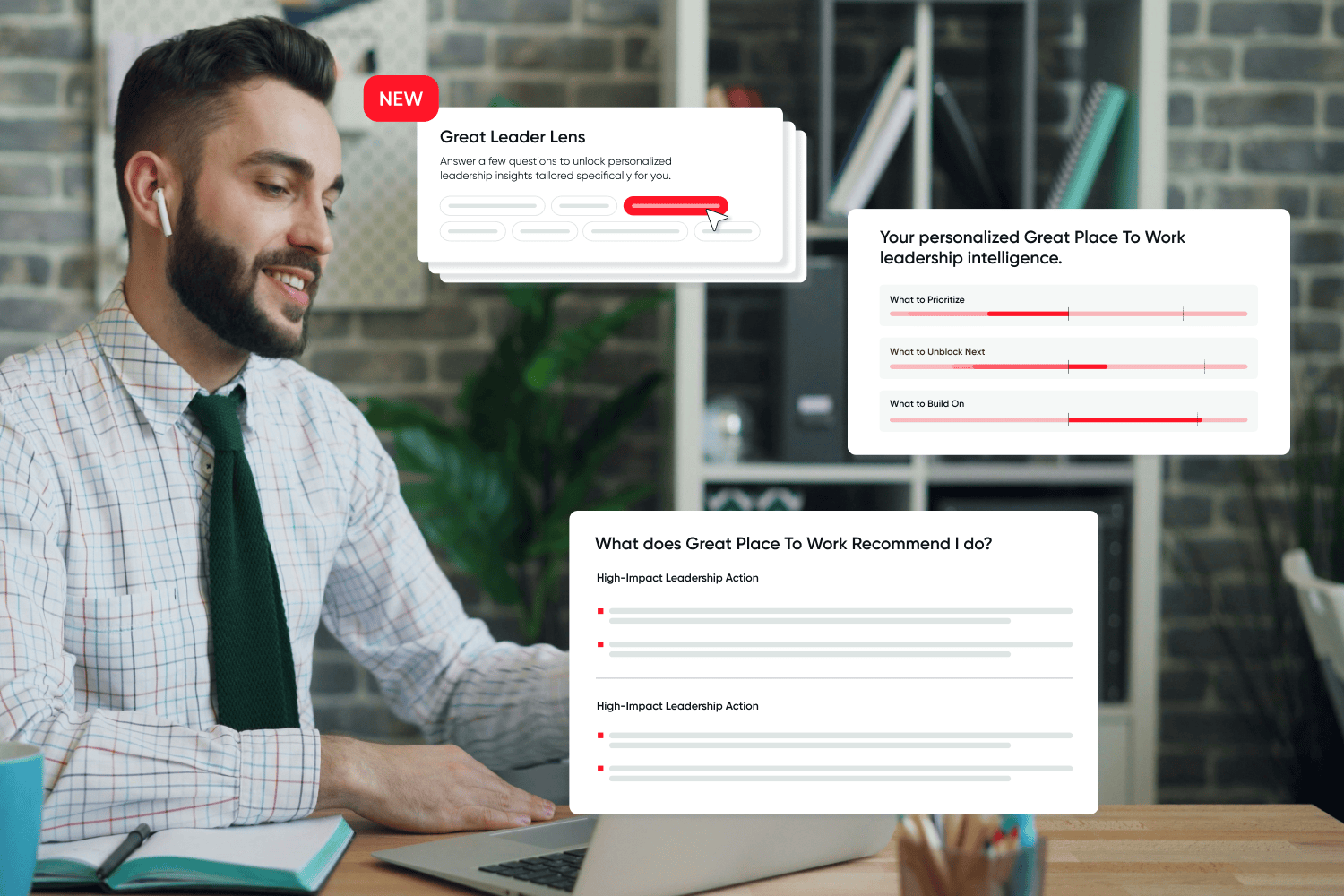
Turn Leadership Intent Into Employee Experience
The Great Place To Work® Trust Index™ Survey shows organisations where trust is strong, where the experience is inconsistent, and which leadership behaviours should move next.
That is why culture cannot be delegated to communications, and strategy cannot stay inside the executive room. Both become real through the same mechanism: leaders at every level repeating credible behaviours until employees know what they can count on.
The Middle East does not need more ambition. It has ambition in abundance. The organisations that lead the next phase will be the ones that lose the least meaning between the strategy and the Monday morning it lands on.
SOURCES:
– World Economic Forum, Future of Jobs Report 2025
– Gallup, State of the Global Workplace 2026
– Great Place To Work®, 9 High-Trust Leadership Behaviors That Build Great Workplaces, 2025